



If you’ve recently undergone shoulder labral repair surgery or are preparing for the procedure, you’re probably wondering what lies ahead. The good news? With the right guidance and commitment to post-surgical physical therapy for shoulder labrum recovery, you will regain full function and return to the activities you love.
Recovery from labral repair takes time and dedication, but it’s a journey with a successful destination. Understanding what to expect at each phase helps you stay motivated, recognize progress, and avoid setbacks.
What Is Post-Surgical Physical Therapy for Shoulder Labral Repair?
Post-surgical physical therapy shoulder labrum treatment is a specialized rehabilitation program designed to restore your shoulder’s strength, mobility, and stability after labral repair surgery. Physical therapists guide you through carefully sequenced exercises that protect your surgical repair while progressively rebuilding the function you need to return to work, sports, and daily activities.
The labrum is the ring of cartilage that helps keep your shoulder joint stable. After surgery to repair a torn labrum, the tissue needs time to heal while your shoulder maintains some movement to prevent stiffness. Unlike generic exercise programs, physical therapy after labral repair follows evidence-based protocols aligned with your surgeon’s specific repair techniques, with your therapist monitoring progress and adjusting treatment based on how your shoulder responds.
Why Is Physical Therapy Essential After Shoulder Labral Repair?
Physical therapy after labral repair isn’t optional if you want to achieve your best possible outcome. First, PT protects your surgical repair during the vulnerable early healing phase. Your therapist knows exactly which movements are safe at each stage and which could stress the repair before it’s ready.
Second, physical therapy prevents the stiffness and frozen shoulder that can develop when your arm stays immobilized for too long. Controlled, passive movement during the early weeks maintains your range of motion without disrupting tissue healing.
Third, your therapist rebuilds the strength, coordination, and neuromuscular control your shoulder needs to function properly. Labral tears don’t happen in isolation. The surrounding muscles have likely compensated for instability, creating imbalances that contributed to your injury. PT addresses these underlying issues so you return to activities stronger than before.
What Are the Phases of Recovery After Shoulder Labral Repair?
Shoulder labral repair recovery timeline follows distinct phases, each building on the previous one. Most protocols divide recovery into three to four phases spanning approximately 4-6 months total. The exact timeline varies based on your tear location, surgical technique, individual healing rate, and activity goals.
Phase 1 focuses on protection and passive motion while your repair heals. Phase 2 introduces active movement and early strengthening as tissue gains stability. Phase 3 advances to progressive strengthening and functional movements. Phase 4 emphasizes sport-specific training and return to full activity for those with higher demands.
Your physical therapist determines when you’re ready to progress between phases based on objective criteria like pain levels, range of motion measurements, and strength testing.
What Happens in Phase 1: Protection and Passive Motion (Weeks 0-6)?
Phase 1 of your shoulder surgery rehabilitation begins immediately after surgery and lasts about six weeks. This is the most protective phase, when your repaired labrum is healing and most vulnerable to stress.
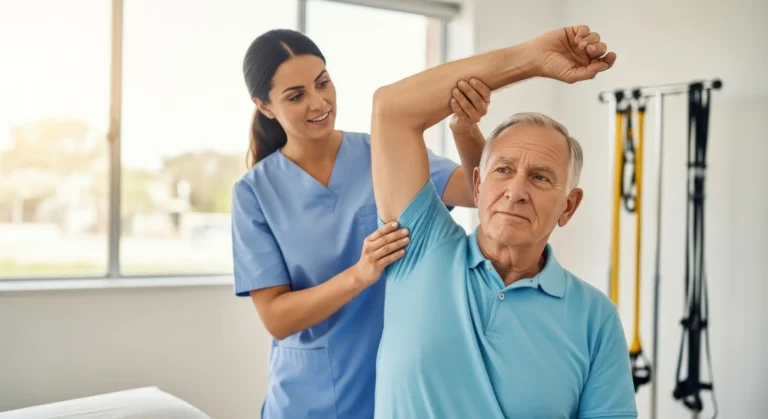
You’ll wear a sling during this phase to immobilize your shoulder and protect the repair. Most patients wear it for approximately four weeks. Physical therapy during Phase 1 focuses on passive range of motion, meaning your therapist or a device moves your arm while your muscles stay relaxed. These gentle movements prevent stiffness without activating the muscles that could pull on the repair.
Pain and swelling management are priorities during these early weeks. You’ll also perform exercises for your elbow, wrist, and hand to maintain circulation and prevent stiffness in the rest of your arm.
This phase requires patience. Following your restrictions precisely during Phase 1 sets the foundation for faster progress later.
What Happens in Phase 2: Active Motion and Early Strengthening (Weeks 6-12)?
As you transition into Phase 2 of your labral repair recovery exercises, the focus shifts toward reclaiming active control of your shoulder. By week six, your repair has gained enough stability to begin gentle strengthening while continuing to expand your range of motion.
You’ll discontinue sling use during this phase. Now you can begin active range of motion exercises, where you move your arm using your own muscle power. These movements start small and gradually increase as your shoulder tolerates them.
Early strengthening begins with isometric exercises, where you contract your muscles without moving the joint. As the phase progresses, you’ll add resistance bands and light weights to challenge your rotator cuff and scapular stabilizers.
Your therapist pays close attention to your movement patterns during Phase 2, correcting compensations before they become habits. By the end of Phase 2, you should have a significantly improved range of motion and the strength to perform daily activities like dressing, grooming, and light household tasks without discomfort.
How Long Does Recovery Take After Shoulder Labral Repair Surgery?
The complete shoulder labral repair recovery timeline varies by individual, but most people return to full activity between four and six months after surgery. Several factors influence this timeline.
Your tear location and complexity affect recovery duration. Simple anterior labral tears heal more predictably than complex 360-degree tears or SLAP lesions involving the biceps attachment.
Activity demands determine your endpoint. Returning to desk work may take 3-4 months, while athletes resuming overhead sports like baseball or swimming need 5-6 months or longer. Age, overall health, and pre-surgery conditioning also play roles in healing speed.
Consistency with your home exercise program significantly impacts your timeline. Patients who diligently perform their prescribed exercises between PT sessions progress faster than those who only work during appointments.
Recovery isn’t linear. You’ll experience plateaus where progress seems stalled, then sudden improvements when everything clicks. If you’re still in the planning stages, learning about Shoulder Labral Repair Pre-Surgical Physical Therapy can help you set realistic expectations before your procedure. Trust the process and communicate openly with your PT about any concerns.
How Can Bull City PT Support Your Post-Surgical Recovery?
At Bull City PT, we specialize in post-op shoulder physical therapy and understand exactly what you need at every phase of your labral repair recovery. Our expertise in post-surgical orthopedic rehabilitation means you’re working with therapists who have guided countless patients through this exact journey.
We begin with a comprehensive evaluation that considers your surgical report, current symptoms, movement quality, and personal goals. This allows us to create a truly personalized recovery plan rather than following a generic protocol. Throughout your recovery, we continuously monitor your progress and adjust your treatment plan accordingly.
Our state-of-the-art Durham facility provides access to specialized equipment and treatment techniques that optimize your recovery. We also offer convenient locations in Charlotte and Brier Creek for Triangle-area residents.
If you’ve started physical therapy elsewhere but aren’t satisfied with your progress, North Carolina’s Direct Access laws allow you to switch providers without a new referral. We accept most insurance plans and will verify your benefits so you understand your coverage before your first visit.
Ready to take the next step in your recovery? Experience personalized physical therapy at Bull City PT, where your comfort and recovery are our top priorities. Our dedicated team in Durham is here to help you every step of the way. Contact us today to schedule your evaluation and start your journey back to full function.